Showing posts with label Strategies. Show all posts

Thursday, January 20, 2011

Merger Arbitrage Candidates: Interesting Reads

Following up on Risk Arbitrage Back On?, today Morningstar (MORN) and its unit Footnoted published their respective 2011 M&A outlooks, along with a list of top takeover candidates:
CHICAGO, Jan. 20, 2011 /PRNewswire/ -- Morningstar, Inc. (Nasdaq: MORN), a leading provider of independent investment research, today published its Merger & Acquisition Outlook for 2011, a comprehensive research report that outlines merger and acquisition trends by sector, identifies the 100 most likely takeover candidates across Morningstar's equity coverage universe, highlights the likely acquirers, and examines the implications of merger and acquisition activity for bondholders.
"While global merger and acquisition activity has been on the decline over the last few years, we observed the inklings of a revival in 2010 and expect both the number and size of deals to substantially increase in 2011," said RJ Hottovy, director of equity research for consumer stocks and editor of the report. "We expect some of the key M&A themes to include interest in emerging markets, companies that have mastered a unique niche in their respective industries, and the ability to generate free cash flow."  


Interesting reads:


Morning Star M&A Report


FootnotedPro2011

ETF Mania, or: A Study of Herd Behavior

Nestled on page B11, in this weekend’s Wall Street Journal was an article, “Social” Funds Embrace Emerging Markets.

One of the fads that’s irked me for some time is Socially Responsible Investing.  
Surely, that must go against the whole capitalist ethos, no?
What does Socially Responsible Investing even mean? And I don’t mean the wikipedia definition. I mean,  you’ve got 30 secs to explain it to me........... go!

Uh huh, thats what I figured. Sounds good though, right? All you need is a prospectus plastered with an image of giggling children frollicking in a field of daisies, under a sun filled sky et voila.
This whole ETF and theme-based fund frenzy is really getting out of control.


This one fund in particular, the MMA Praxis International Fund(MPIAX), aims for 20% Emerging Markets exposure, screening for companies that produce alcohol, tobacco and weapons. Therefore, mining and sweatshops that employ cheap efficient labor have a free pass.

Talk about coming to the party late and with nary so much as a cheap bottle of plonk. While procrastinating over how the write researching this post, along comes the WSJ with Here Comes The Dumb Money (hat tip stonestreetadvisors). Gee, I wish i’d thunk o’ that title.  

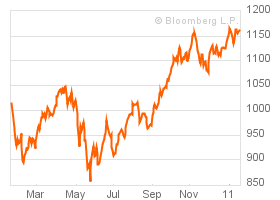
Because over the last year, the MSCI Emerging Markets Index has risen over 35%:


And since 2008 over 142% - Not to also mention that HUMONGOUS Volume spike during Sept of last year:


And inflows for the week ending Jan 14th 2011 show that the leading Emerging Markets ETF, Vanguard’s Emerging Markets ETF (VWO) was once again among the ETFs with the highest inflows ($840mn).  Admittedly, the iShares MSCI Emerging Markets Index (EEM) was among the ETFs with the highest outflows (-$1.1bn).   

However, I believe the outflows from EEM has more to do with cost of VWO (ubercheap), and EEM lagging the MSCI Emerging Markets Index. Perhaps, lately a third reason - How EEM is structured.

VWO uses a replication strategy (it seeks to own as many of the underlying stocks in the index as possible),  holding as many as 800 stocks. EEM on the other hand uses a sampling strategy designed to deliver the index’s returns without owning all the securities in it and “optimizes” - a not-so-clever euphemism for backing the truck up on derivatives.  

Understanding ETF methodologies is an important criteria that is often overlooked by both professional and retail investors.  Of the roughly 1200+( numbers change frequently with additions and closures) ETF and ETNs that can be traded, maybe 75 are truly understood and should be traded.   
The rest are an exercise in futility, pandering to the masses desire for an investing elixir.
This is all part of the greater trend of investors missing out on a rally, and getting into the latest fad/innovation to jump start gains. Ordinarily, you would chuckle at the "dumb money", but plenty "smart" money gets in on the act too. 
You’ll know we hit bottom when there is an art mutual fund/ETF or worse an ETF that allows investors to Put Money on Lawsuits to Get Payouts.  Look carefully before you leap. 
Happy Trading

Friday, January 14, 2011

Risk Arbitrage back on?

A NYtimes DealBook article, Return of the Risk Arbs, declared betting on mergers is back from the dead in November 2010:

We're seeing people dip their toe back in the water and participate, said Keith M. Moore, a managing director at MKM Partners in Stamford, Conn.

Many investment banks echo'd that sentiment in their 2011 outlooks, proclaiming mergers will return with a vengeance in 2011, with the rationales being:

  • Healthy corporate balance sheets with access to accommodative financing and reasonable or some might say cheap valuations.
  • The need to buy growth.
  • Product and or geographic extension.
  • Cost rationalization.
I would, however be remiss in not including the improving swagger of CEOs with an appetite for destruction, deal making.

With mergers being back in fashion, we might see the re-emergence of risk arbitrage or merger arbitrage, one of the most popular hedge fund strategies. So time to brush up on the strategy, review any new FTC guidelines and crank up "ye olde arb spreadsheet".

So, what is risk arbitrage? I can tell you it is not buying stock in a company because uncle Vito said “something’s gonna happen, so get stuck in”. Although, it would probably be highly profitable, it is not arbitrage and can be illegal. Along the same lines is rumortrage – it means just what you think it does -, those in the market know what I mean – particularly the denizens of Foreign Exchange trading. Sometimes rumortrage works but more often than not that “strategy” results in loss or break even at best minus costs, of course.

Risk arbitrage is the systematic arbitrage of corporate events, wherein the terms of the event specify exactly what investors will receive in exchange for their holdings when the operation effectively closes. These corporate events include mergers, tender offers, exchange offers, liquidations, spin-offs, and corporate reorganizations. For a more detailed discussion of risk arbitrage click here.

One such corporate event was announced on Monday January 10th. Duke Energy (DUK) and Progress Energy (PGN) announced that their board of directors have agreed to merge the two companies, with DUK offering 2.6125 shares of Duke for every one of PGN, in a deal valued at $38 billion (inclusive of $12 billion in debt).

Highlights

  • The pricing represents a 7% premium for PGN Shareholders to the stock price on January 5th and a 4% premium to the January 7th close.
  • It would also represent a 3% dividend increase for PGN Shareholders, based on DUK’s current dividend.
  • Both companies expect the deal to be accretive in its first full year and expect the deal to close by year-end 2011.

Approvals & Timing

  • Completion of the merger is conditioned upon, among other things, the approval of the shareholders of both companies, as well as expiration or termination of any applicable waiting period under the Hart-Scott-Rodino Antitrust Improvements Act of 1976.
  • Other necessary regulatory filings include: Federal Energy Regulatory Commission (FERC), Nuclear Regulatory Commission (NRC), North Carolina Utilities Commission (NCUC) and South Carolina Public Service Commission (SCPSC).
  • DUK’s current northern states (IN, KY, OH ) as well as PGN’s FL jurisdiction only require notice and will not have to approve the deal.

On the conference call discussing the merger, Progress CEO Bill Johnson shed some light on the merger rationale, that of reducing costs and improving the company’s credit rating to meet new environmental regulations.

With the current spread at $2.07 with a retrurn 4.6% (Duke has a dividend due on 2/9/11 of $0.245, which puts the current spread at $1.43 and the return at 3.23%).

As with the Cinergy merger in 2005, the timing for deal closure will be between 12 and 18 months. Which should keep thr annualized return in the 3.25% - 3.30% ball park based on current spread of $2.07($1.43 - DUK dividend).

Not super sexy, yet nothing to sneeze at considering 5 year treasury is yielding 1.96%.

I will update the blog, once the offer document is released and I have had time to go over it.

Happy Trading

(Full disclosure, I have a position on at $2.05 spread.)


Duke Energy and Progress Energy Service Territories.


Advisors
J.P. Morgan served as lead financial advisor and provided a fairness opinion to Duke Energy, and BofA Merrill Lynch also provided a fairness opinion to Duke Energy. Lazard Frères served as lead financial advisor and provided a fairness opinion to Progress Energy, and Barclays Capital also served as a financial advisor and provided a fairness opinion to Progress Energy. Wachtell, Lipton, Rosen & Katz served as legal counsel for Duke Energy. Hunton & Williams LLP served as legal counsel for Progress Energy.

SW489XJZV6RF